You’ve recovered from the holiday frenzy, but now it’s time to head into Q1 with everyone’s favorite winter non-holiday: Valentine’s Day.
Over half (59%) of consumers around the world celebrate Valentine’s Day, according to Drive Research. And while it may not be an official holiday, it’s definitely a day to spend money.
As a marketer, how do you make the most of the occasion? Here are 11 creative ideas, even if your brand doesn’t fall into the typical jewelry, chocolate, and flowers Valentine’s Day categories.
1. Improve Valentine’s Day communication with data
No one wants to suffer through a date with someone who talks about themself the entire time. The same principle applies to your online store and marketing messages.
Sure, one goal of marketing is to sell your products. But the more questions you ask your customers, the more you can personalize your marketing content with customer data.
Here are a few form data collection ideas that can pay off for Valentine’s Day:
- Find out if customers are shopping for themselves or someone else.
- See if folks are just browsing or looking for a specific gift.
- Ask about relationship status.
- Learn the customer’s gift budget range.
- Identify product-specific preferences.
- Take note of shoppers’ anniversary dates, so you can send future anniversary emails.
If a customer indicates that they’re shopping for themself, for example, enter them into a “treat yourself” marketing automation segment. Or, if a shopper checks “just browsing,” send them to a gift guide.
Personalization is important after the sale, too. Use product and customer data to send relevant care instructions, education, review requests, and product suggestions that can boost retention after Valentine’s Day is over.
Personalized marketing example: Maison Miru sends product-specific care instructions
When the team at Maison Miru, a modular jewelry brand, noticed a lot of questions coming in about specific types of jewelry, they turned to automated email flows to improve the customer experience.
Now, as part of Maison Miru’s transaction flow, a post-purchase email goes out two days after a customer places an order. The email is personalized based on the item the customer purchased and shares tips on how to care for and wear the new jewelry.
2. Launch a Valentine’s Day gift finder quiz
Create an interactive quiz that can help shoppers discover gifts for themselves, their friends, or their significant others. Use behavioral data from quiz responses to segment customers and send them hyper-personalized campaigns across multiple channels.
Each quiz result can feature a curated product collection, trigger a message series with tailored recommendations, or direct the subscriber to create a personalized wishlist within their self-serve customer hub.
When visitors engage with quizzes, you’re learning something valuable about what they need. This is how you can shift from passive form-filling to active discovery, which can make it more fun for the customer to build lists and browse.
Valentine’s Day marketing example: POPFLEX asks shoppers to enter a giveaway with a style quiz
As part of a Valentine’s Day promotion, activewear brand POPFLEX asked their Instagram audience to complete a style quiz to enter a special giveaway. The promotion was an investment in customer data: the responses helped them get to know their audience better, reach customers on multiple channels, and offer more personalized recommendations.
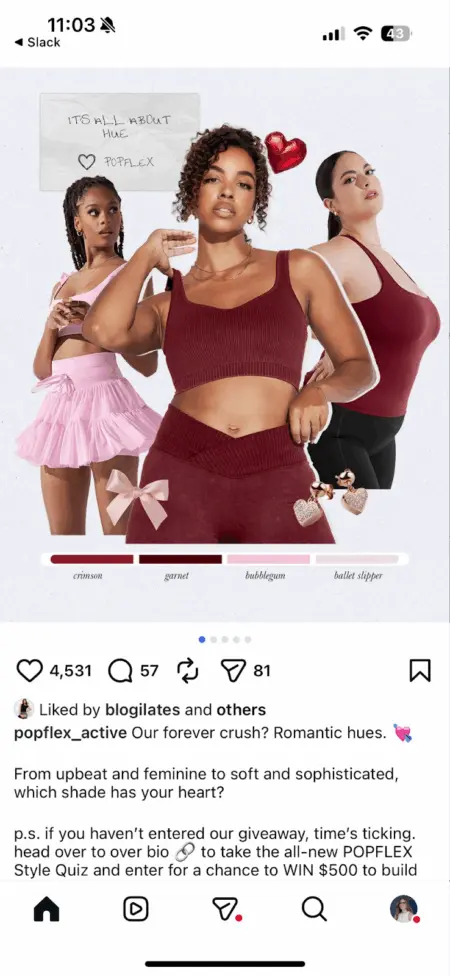
Source: POPFLEX Instagram
3. Use autonomous service to offer 24/7 gift consultation
Choosing gifts for loved ones is never easy. For Valentine’s Day, the pressure is especially high.
Offer shoppers instant help finding the perfect Valentine’s Day gift with autonomous service: AI shopping assistants that can answer questions and make product recommendations 24/7, across channels, with little or no human help.
Let’s say someone wants to build a custom flower bouquet for their spouse, but they don’t know anything about flowers. Your AI customer agent can ask some simple questions to help narrow things down, which can speed up the decision making process.
As customers chat with your AI shopping assistant, they can also get reassurance on other hesitations like shipping costs and timelines, which can often lead customers to abandon their carts.
AI-assisted marketing example: Ministry of Supply personalizes the shopping experience with an AI agent
Clothing brand Ministry of Supply implemented an AI customer agent that resolved 84% of product recommendation chat queries autonomously in a 60-day period.
“The most common things we see customers want in a bespoke shopping experience are details on what they got last time, and what we think they should get this time,” Ministry of Supply CEO Aman Advani says. The combination of an AI customer agent and a self-serve customer hub, Advani says, gives customers “easy access to both of those things.”
Ministry of Supply’s AI agent also offers customers a choice between immediacy and a personal touch, with a “talk to a human” option available throughout their experience. In a Valentine’s Day context, both options could mean offering a better last-minute shopping experience and easier access to the ability to customize a gift.
4. Match your Valentine’s Day offers to customer signals
Everyone loves a good deal, especially after they’ve probably spent quite a bit during the holidays.
But customers won’t all love the same deal, so it’s important to develop several types of offers that make sense for different customer segments. This is the best way to offer incentives in your marketing emails, text messages, or social media promotions that encourage higher order values without eating into your margins.
Match your offer to customer intent, purchase history, and context to maximize conversions. For example:
- Free gift wrapping or gift cards for last-minute shoppers
- “Buy one for them, get one for yourself” for self-gifters
- Free gifts with purchase for higher spenders
- Tiered discounts based on cart value to encourage larger gift purchases
Valentine’s Day marketing example: Happy Wax rewards high-value purchases
Rather than discounting products and reducing margins for their Valentine’s Day promotion, Happy Wax uses a gift-with-purchase strategy that accomplishes multiple goals at once.
The home fragrance brand offers big spenders who hit a minimum spending threshold ($85) a free candle from their Valentine’s Day collection. This encourages customers to add more items to their cart to qualify, increasing average order value beyond what a percentage discount might achieve.
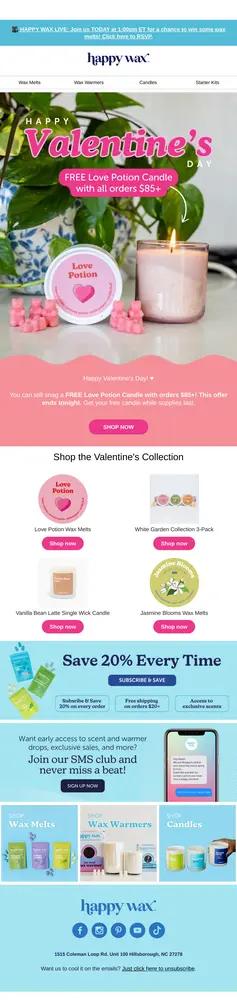
Source: Milled
5. Create an expert Valentine’s Day gift guide
Gift guides are two strategies in one: they position your brand as a trusted advisor while giving your customers gift ideas based on your inventory.
One of the best ways to strike gold with this Valentine’s Day marketing and CRM strategy is to crowdsource a gift guide from your team, complete with headshots and quotes.
Build gift guides for different audiences, like “gifts for him,” “luxury picks under $300,” and “last-minute digital gifts.” Send gift guides based on browsing and purchase history, or share the “for him” guide with someone who historically buys men’s products and the luxury guide with people who usually spend more.
If you have the option to speed things up, prompt an AI marketing agent to generate personalized messaging and on-brand copy for promotions.
Valentine’s Day marketing example: Trade Coffee shares staff picks
Trade Coffee used a straightforward subject line for this email: “Our Valentine’s Day Gift Guide.” The brand sent the email a solid week before Valentine’s Day, with a clear shipping deadline.
One of the reasons this email is so good is the staff quotes. They act as great product descriptors that come from real humans, as if you’re getting a recommendation from an expert who’s passionate about coffee.
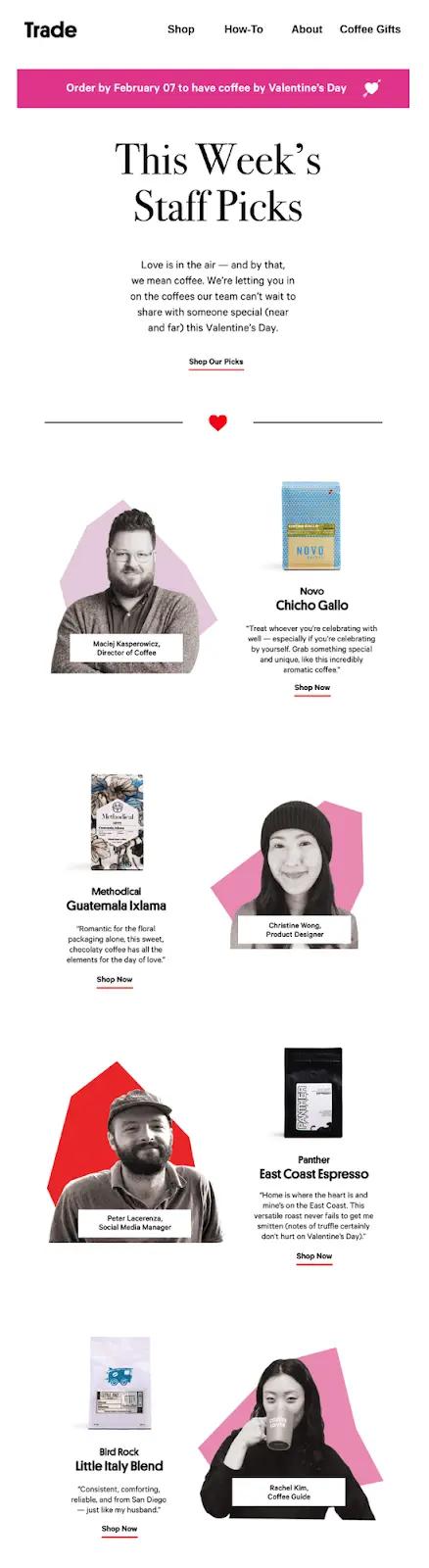
Source: Klaviyo Showcase
6. Win back your ex…customers
While your ex may have ghosted you, your previous customers might be a little more receptive to your overtures—if the offer is right.
For customers who purchased from you last February but haven’t bought from you since, now’s the perfect time to put a Valentine’s Day win-back series into action.
Create a segment of customers who purchased last Valentine’s Day but haven’t made a purchase since. Launch a win-back flow starting in late January: “We miss you! Here’s 20% off to welcome you back.” Use dynamic content to showcase products similar to what they bought last year.
Then, send a personalized nudge on February 10–12: “Last year you loved [product]. This year we think you’ll love [similar item].” Create urgency with shipping deadlines or a countdown timer, and consider offering free express shipping as a special incentive.
Win-back marketing example: KURU reminds customers why they fell in love with the brand
Footwear brand KURU sent this win-back email with the headline “Support Worth Coming Back For” and customer testimonials like, “Where have these shoes been all my life?”
The email reminds lapsed customers of the brand’s core value proposition (comfort and pain relief) through social proof, then showcases their ROAM collection with easy “Shop Women” and “Shop Men” CTAs.
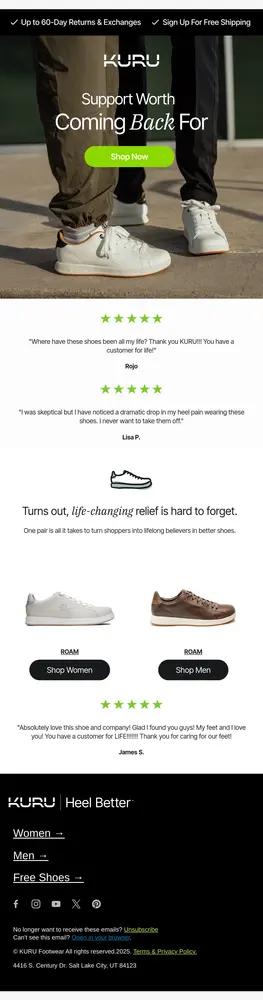
Source: Milled
7. Lean into Galentine’s Day to expand your revenue potential
Remember: people aren’t only buying for their significant others on Valentine’s Day. They’re also buying for friends, children, parents, and even themselves.
According to YouGov, 60% of adults believe Valentine’s Day is a holiday for both romantic and platonic relationships. Galentine’s Day on February 13 is also a massive untapped revenue opportunity.
Celebrate friendship with Galentine-specific campaigns starting in late January or early February across email, text, WhatsApp, and push notifications. Create gift bundles perfect for friend groups: matching PJs, spa sets for two, or “friendship packages” at various price points.
Segment customers who frequently purchase multiple items or have a history of buying gifts for birthdays and holidays. Leading up to Galentine’s Day, send a targeted text campaign: “Galentine’s Day is tomorrow! Order by 5 p.m. for delivery by the 13th.”
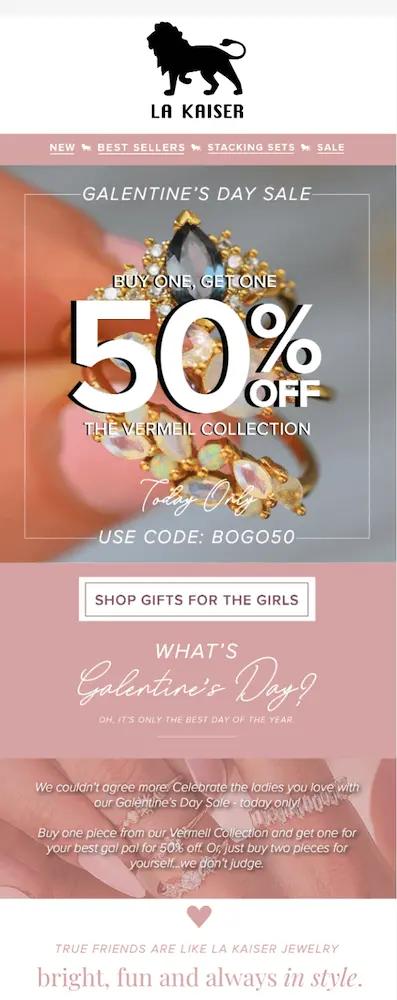
Valentine’s Day marketing example: La Kaiser says jewelry is perfect for Galentine’s Day
Take a look at this Galentine’s Day sale email from jewelry brand La Kaiser, which incorporates:
- A discount code for big savings (50% off)
- A cheeky, playful explanation of Galentine’s Day
- High-quality product images
- Well-placed CTA buttons, including one above the fold
Source: Klaviyo Showcase
8. Use text messaging and WhatsApp for last-minute Valentine’s Day marketing
According to Klaviyo’s recent global texting takeaways report, 65% of people say a promotional text message influences them to buy sooner than planned. That means mobile-first channels could be your secret power for February 12–14.
But Valentine’s Day shoppers don’t all engage in the same way. Some check email every hour, others prefer texts, and many jump between channels throughout their buying journey.
Rather than sending duplicate messages everywhere, build an omnichannel campaign that targets key moments and uses AI-powered channel affinity to identify where each individual customer is most likely to engage next and respect channel preferences:
- February 10: Send an initial reminder via each customer’s top channel with a subject line like, “Valentine’s gifts: 4 days left for guaranteed delivery.”
- February 12: Follow up on a second-ranked channel for non-converters, with urgency-focused messaging: “Only 2 days for Valentine’s delivery! Shop express shipping gifts.”
- February 13: Send a final push via WhatsApp or RCS for high-intent browsers who haven’t purchased, featuring rich media like product carousels and quick check-out buttons.
- February 14: Pivot to digital gift options (gift cards, e-certificates) via SMS for procrastinators who are still browsing.
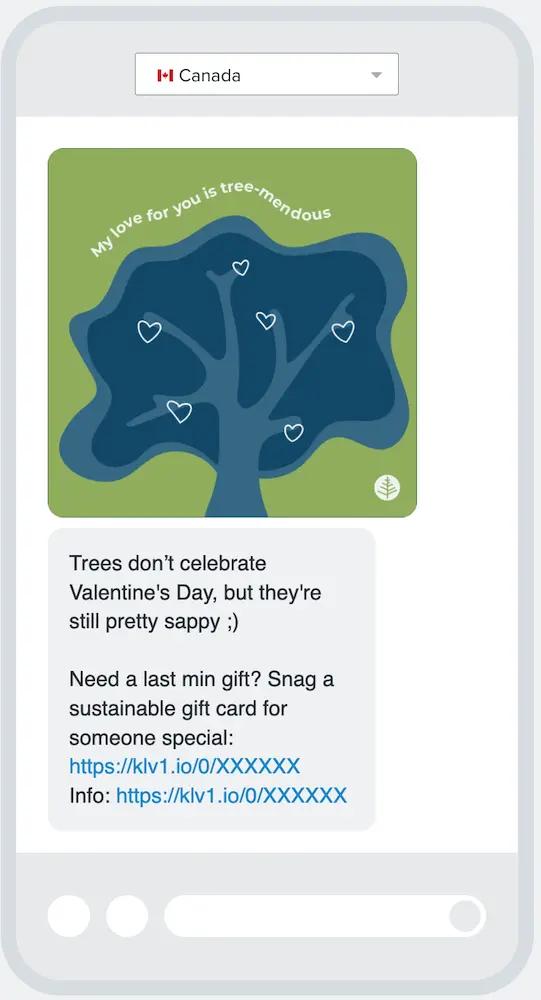
Valentine’s Day marketing example: Earth Hero converts procrastinators with timely texts
Sustainable goods brand Earth Hero sent this Valentine’s Day text message just one day before the holiday. It’s a smart move—by this point, shoppers are under pressure to deliver a gift in the next 24 hours.
Source: Klaviyo Showcase
9. Ask customers to spread the love with post-purchase review requests
After someone buys a Valentine’s Day gift and has a smooth post-purchase experience—whether that’s a fast check-out, helpful customer service interaction, or on-time delivery—that’s the ideal moment to ask them to share their feedback with a timely review request.
When customers feel good about their experience, they’re more likely to leave positive reviews. Once you collect that feedback, you can thank reviewers with an incentive while expanding your reach beyond peak Valentine’s season.
Valentine’s Day marketing example: Buoy rewards reviewers with bonus loyalty points
Buoy makes unflavored, unsweetened liquid electrolytes that go with any beverage. For every post-Valentine’s Day review they received, they added 500 bonus points to reviewers’ accounts, which customers could use immediately by getting 10% off their next purchase.

Source: Really Good Emails
10. Partner with complementary brands for “perfect pairing” bundles
Team up with (non-competing) brands that share your target audience to create co-branded Valentine’s Day gift bundles. Think wine and gourmet chocolates, skincare and silk pillowcases, or candles and luxury bath products.
Cross-promotion expands your reach while offering customers curated, ready-to-gift options. Coordinate campaigns with your partner brand to identify overlapping audiences and high-value segments.
When running co-branded campaigns, you’ll need to understand which partner’s marketing efforts are actually driving conversions—without double-counting or losing sight of the full customer journey.
Use omnichannel analytics to measure how all messages and channels contribute to conversions, track engagement, and understand which flows perform best across different stages and touchpoints.
Partnership marketing example: Beekman 1802 collaborates with Hershey’s for a sweet skincare treat
Natural skincare brand Beekman 1802 partnered with Hershey’s to create a chocolate-scented collection. The collaboration paired Beekman’s natural skincare expertise with Hershey’s iconic brand recognition, creating gift sets that appeal to both brands’ audiences: beauty enthusiasts and chocolate lovers looking for unique, indulgent presents.

Source: Milled
11. Run a post-Valentine’s Day self-love extension campaign
Valentine’s Day fun doesn’t need to end on the 14th. Launch a self-love campaign February 15–21 that targets everyone who didn’t buy anything during the Valentine’s Day rush.
Or, nurture customers who were active during Valentine’s Day with a special promotion for them to treat themselves for treating others.
You can use an AI marketing agent to quickly build out your extension campaign, featuring products that sold the best during Valentine’s Day. Generate fresh messaging, like positioning around self-care instead of romance.
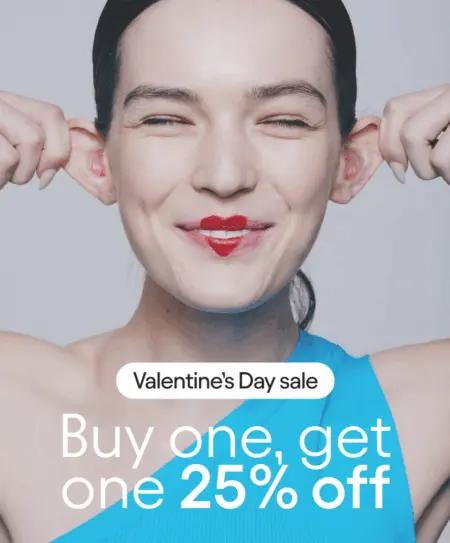
Valentine’s Day marketing example: Loop extends Valentine’s Day promotion for self-gifters
Earplug brand Loop ran a post-Valentine’s Day campaign with the message, “Valentine’s Day may be over, but there’s still time to treat yourself (or someone you love),” offering a buy-one-get-one 25% off deal.
The deal helped the brand capture post-holiday shoppers without the pressure of February 14 deadlines. By explicitly calling out both self-gifting (“treat yourself”) and belated gifting (“or someone you love”), they address multiple customer segments: people who missed the deadline, those who might want to buy for themselves, and customers looking for friendship gifts.
Source: Milled
Build 1:1 customer relationships at scale with Klaviyo
During Valentine’s Day, take the opportunity to connect with your customers through personalized moments.
Klaviyo B2C CRM makes it easy for brands to collect customer data and deliver personalized experiences at every step of the customer journey. By combining marketing automation, customer service, and analytics in one platform, Klaviyo makes it possible to personalize interactions for every Valentine’s Day customer—without losing the details that matter.
Connect with customers all year long with Klaviyo.
Sign up
Related content