Your customers expect two things from support: quick answers and continuity. If they come back with a question, they don’t want to start from scratch or repeat their story.
Meeting this expectation comes down to your customer service technology—and most brands think they’re doing well. According to Klaviyo’s 2026 customer service research, 90% of service leaders say they’re satisfied with their customer service technology, and 77% say recent investments in tech delivered measurable ROI.
But even with automation and fewer gaps, many customer service tech systems still fail when customers switch channels or follow up. The experience ends up feeling fragmented for the customer, even if the platforms technically work.
In 2026, improving your customer experience requires a customer service tech stack that works as one connected system. When customer data lives in one place, context follows the customer, agents can work faster and more effectively, and automation and AI deliver actual value.
Here’s what belongs in your customer service tech stack in 2026, and how integrated systems can help teams deliver faster, more personalized support.
1. A B2C CRM with a built-in customer data platform
For customer service teams at consumer-facing brands, the B2C CRM is where customer support starts. CRMs centralize customer data from different parts of the journey, so customer service teams can respond with context when handling a support inquiry.
The trouble starts when that view is incomplete. Orders, refunds, browsing activity, and preferences often sit in separate platforms. Our customer service research found that one-third of service teams use 8 or more tools in their tech stack.
If some of these tools are bringing in customer data that customer service teams can’t see, agents won’t be able to serve customers with full context. That means even if an agent can reply quickly, the experience won’t be as smooth or as personalized as shoppers expect it to be.
Here, data quality matters, too. According to our customer service research, 62% of teams use a CRM, but only 29% of leaders say their data quality is “excellent.”
A CRM with a built-in customer data platform (CDP) improves data quality without adding another tool to the mix. Customer data from every channel flows into a single profile that updates automatically as people browse, buy, and reach out for help.
With a strong data foundation in place, agents don’t need to jump between tabs or ask customers to repeat themselves. And, AI agents and self-service platforms (more on these next) work more reliably because they’re grounded in a customer’s complete history.
Specifically, CRMs help customer service teams:
- Respond faster with full context about the customer’s unique journey.
- Personalize responses based on a customer’s behavior and history.
- Prioritize loyal or high-value customers and treat them like VIPs.
- Feed data back to marketing teams, so they can adjust their messages to reflect service interactions.
- Make relevant product recommendations to increase repeat purchases.
- Keep their tone consistent across channels, even when multiple team members jump in.
Luxury cabin rental brand Elk Springs Resort saw this firsthand after moving to a unified CRM with customer profiles that pull in real-time data. The team uses automations to create more personalized experiences for their customers.
For example, the brand sends proactive messages that answer FAQs—like directions, check-in instructions, and safety details—tailored to each guest’s cabin and booking time, beforeguests even have to ask. According to owner Andy Gladstein, their customer service team is “about 30% the size of a comparable company’s” because they use their tech stack to handle routine communication automatically.
2. Self-service knowledge bases and customer portals
90% of consumers want self-service support options, according to Microsoft. It makes sense: tapping a link or checking an article often feels faster and more convenient than starting a conversation.
Our customer service research found that only 27% of support teams offer a customer self-service portal, but 38% are planning to implement one in the next year. An on-site customer portal gives shoppers a central place to manage their orders, track shipments, and find answers, all without hunting through emails or logging into multiple accounts.
When customers can solve common issues on their own, support volume goes down and your team has more time for complex problems. Self-service knowledge bases and customer portals can also improve the customer experience by:
- Allowing customers to track their orders, manage returns, and update subscriptions
- Surfacing personalized product recommendations based on purchase history
- Consolidating loyalty rewards, coupons, and orders in one place
- Making re-ordering easier and faster
- Embedding FAQs and AI customer agents within the shopping experience
Take specialty coffee company Coffee Beanery. They recently added a self-service customer hub—a personalized, signed-in account experience that lets customers access orders, rewards, support, and more—to their tech stack. In just over two months, their customer hub drove more than $8,000 in revenue.
3. AI customer agents or shopping assistants
Our customer service research reveals that teams investing more heavily in self-service are 72% more likely to use AI agents or virtual assistants than teams that aren’t. AI customer agents are fast becoming part of how customer service teams handle everyday questions at scale: 45% of teams report using AI agents, often alongside other self-service tools.
It’s a smart move, according to consumers: Klaviyo’s 2025 AI Shopping Index found that 81% of consumers used AI shopping assistants in 2025, and 68% prefer AI agents over humans for instant answers.
When an AI agent is trained on the data foundation a CRM provides, it’s pulling answers and responses from product details, order status, and recent activity tied to that customer—the same data your human agents use. This changes how brands distribute service work.
Here’s what AI agents are most adept at handling:
- High-volume, routine questions: AI agents resolve high-volume, routine questions like policy FAQs and “where is my order” inquiries, while human agents focus on situations that require judgment, exceptions, or reassurance.
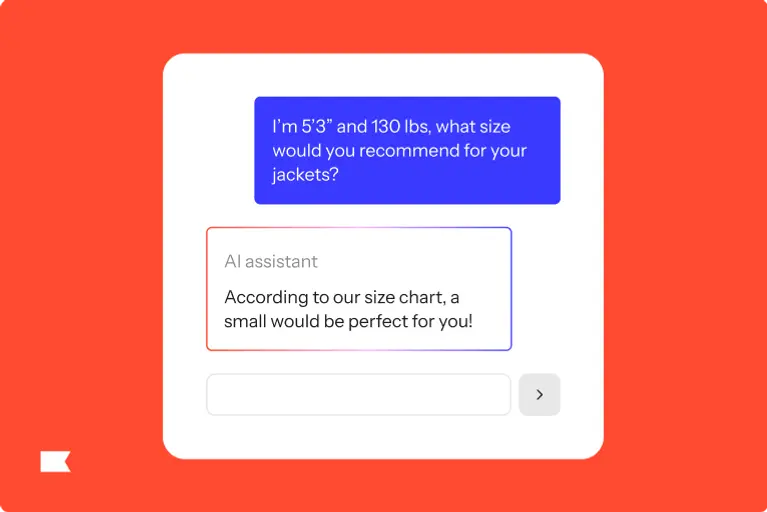
- Questions during browsing and check-out: AI customer agents are also helpful during the shopping process. They can recommend products based on browsing behavior or past purchases, helping customers move forward with a purchase without leaving the product page.
- Smooth handoff to a human agent: If a conversation goes beyond what AI can handle, the AI agent escalates the conversation to a human with the full history intact, including what the customer asked and how the AI agent responded.
Clothing brand Ministry of Supply uses an AI customer agent to support real-time shopping questions. Over a 60-day period, the agent resolved 84% of product recommendation conversations without human involvement. This is how Ministry of Supply can create a more curated, 1:1 experience for every customer without maxing out their service team.
4. Live chat and messaging platforms
Shoppers turn to live chat when they get stuck during an order or need an answer before moving forward. Even with AI agents available, many customers still want to talk to a human when money, delivery, or product issues are involved.
As customers switch between devices and channels throughout the day, conversations don’t always stay in one place, making coordination across channels tricky.
But instant answers like the ones facilitated by live chat and messaging platforms can help reduce cart abandonment by quickly addressing questions about return policies, shipping estimates, sizing, discounts, and fit, giving customers the confidence they need to click “buy.”
Support conversations that begin in live chat can boost the relevance of other messages, too. A quick follow-up via text or in-app message can share next steps without creating another support ticket or even generate more revenue with an informed product recommendation.
Our customer service research shows that 46% of support teams already use real-time messaging, with another 27% planning to add channels like text messaging, social messaging, and live chat in the next year.
5. An AI-powered helpdesk
As support conversations spread across email, chat, text messages, and social, basic shared email inboxes can’t keep up across channels. Sure, multiple agents can reply to customer emails, but ownership gets murky, and messages inevitably slip through the cracks.
That’s why many brands are moving to AI-powered helpdesks with unified workspaces that can manage omnichannel support conversations at scale: according to our customer service research, 44% of teams report using helpdesks or ticketing systems.
In 2026, AI-powered helpdesks are helping customer service teams address omnichannel volume by centralizing AI and human agent conversations in one place that accesses real-time customer data—no matter where the customer initially reached out.
In addition to enabling AI agents to escalate conversations to human agents when necessary, this kind of helpdesk uses AI to route messages by topic or urgency, so agents can serve customers based on priority and their own expertise. And if a conversation jumps from one channel to another, the history goes with it.
- For customers, this creates a more consistent omnichannel experience. Conversations don’t restart when they switch channels or agents, and support feels smooth from start to finish.
- For customer service teams, the impact shows up in speed and quality. An AI-powered helpdesk automates routing and handoffs that come with complete customer context, so human agents can serve customers across channels without context switching.
Tea brand Harney & Sons saw this play out after moving to a CRM-embedded helpdesk with an AI customer agent. Before, their customer service team worked across multiple tabs, which slowed responses and made conversations harder to follow.
Now, an AI customer agent handles support and recommendation queries. If a human is needed, the AI agent passes the conversation to the helpdesk inbox with full context, so the service team can take over smoothly.
The result has been faster service without added complexity. Within 30 days, Harney & Sons cut average ticket resolution time by 25%.
Reimagine your customer service tech stack with Klaviyo
If your customer service stack grew one tool at a time, it probably does the job. But it might not always feel connected.
Klaviyo Service brings everything together in one place, so your customer service team can operate at their best with full context. Klaviyo Customer Hub, K:AI (Klaviyo AI) Customer Agent, and Klaviyo Helpdesk all run on the same customer data, so your team knows as much about each customer’s unique brand journey as the customer does.
- Klaviyo Customer Hub is a personalized on-site experience where customers can track orders, manage subscriptions, start returns, wishlist items, and discover recommended products. That means fewer common inquiries for your team.
- Customer Agent answers questions automatically, recommends products, and supports customers in multiple languages, around the clock. When a conversation needs a human, it hands off to Klaviyo Helpdesk with the customer's history and prior messages intact.
- Klaviyo Helpdesk brings messages from web chat, text, email, WhatsApp, and social into one AI-powered workspace, with order history, marketing activity, and past support visible in each conversation. It also tags and routes tickets automatically, so the right person sees the right request faster.
With Klaviyo Service, the result is a smoother experience for both sides, and the technology stays in the background where it belongs.
Explore how Klaviyo can help your brand create a smoother customer experience
Sign up
Related content