Email marketing is a form of digital marketing that promotes your products or services to potential and existing customers, shares important information with them, or educates them about your brand. It involves reaching out via email to engage people who have explicitly signed up to receive that type of communication from you, and keep them loyal to your brand.
B2C brands use email marketing to connect with customers and potential customers through promotions, announcements, and other relevant content in order to:
- Raise brand awareness.
- Sell products.
- Educate and inform.
- Build long-term customer loyalty.
Healthy ecommerce brands drive at least 20–40% of their revenue through email marketing, according to growth strategist and entrepreneur Connie Cen. A recent Gartner survey, meanwhile, reveals that email marketing continues to be a top channel investment for CMOs, and ranks as the No. 1 channel for customer loyalty.
And contrary to popular belief, consumers still like email, too: depending on the type of message, 58–64% shoppers prefer email for brand communications, according to Klaviyo’s 2025 BFCM Forecast.
What are the benefits of email marketing?
Compared to paid and performance marketing, which have spent the better part of a decade seducing revenue-hungry businesses with third-party targeting and long marketing attribution windows, email marketing has sometimes been accused of being old-fashioned, tone-deaf—even dead.
With so many flashy marketing channels to choose from, why bother with email marketing? Here are a few email marketing benefits that make it worth your serious investment:
- Email marketing is an owned channel. That means it’s “very much in your control,” says Ari Murray, founder of ecommerce newsletter Go-to-Millions. In a post-iOS 14.5, privacy-first world, where building strong relationships with loyal customers depends largely on your brand’s ability to communicate with them in a way that makes them feel seen, heard, and valued, “owned channels are of the utmost importance.”
- Email marketing generates steady, reliable revenue. Email marketing is also “really reliable revenue if you work it right,” Murray says. “It’s such an inexpensive way to talk to your customers.” (The numbers prove it.)
- Email marketing keeps your funnel healthy. Jen Wallace, director of digital marketing at full-service digital experience agency Northern Commerce, believes marketing channels like email and SMS “represent customer lifetime value,” largely because they allow you to appropriately target every stage of the customer lifecycle. When it comes to developing repeat customers, she says, “email is very hard to beat.”
- Email marketing can solve almost any business problem. What’s the one thing your ecommerce business is struggling with most right now? “Whether it’s revenue, retention, customer experience, customer engagement—all of those can be solved with email marketing,” Cen says.
At the end of the day, Cen says, “the major thing email marketing really helps with is getting worry off your plate.”
How does email marketing fit into a broader omnichannel marketing strategy?
Omnichannel marketing integrates data from different channels so you can create cohesive, personalized experiences wherever your customers are—whether that’s email, SMS, mobile push, or your website.
Email is ideal for moments when customers want depth and detail. It’s a space for storytelling, rich visuals, and comprehensive product information. Within your omnichannel strategy, you can use email marketing to:
- Announce product launches and seasonal promotions with the full context customers need to make decisions, and clickable CTAs to shop.
- Keep customers in the loop with order confirmations, shipping updates, and account notifications.
- Nurture relationships through newsletters, educational content, and loyalty perks.
Email works best when it’s not working alone. By connecting email with your other channels—like following up a browse abandonment email with a timely text message, or using mobile push to remind customers about an expiring offer you initially announced via email—you can reach customers in the right place at the right time, based on how they actually engage with your brand.
What are examples of different types of marketing emails?
Depending on what email marketing strategy you’re supporting throughout the customer lifecycle, different types of email marketing messages will work differently. These different types of emails may be:
- Planned (email campaigns): When planning an email marketing campaign, you create and design a series of messages with a particular purpose that you can either send right away or schedule for a specific time.
- Triggered (email flows): Automated emails, or flows, are messages that send automatically based on specific subscriber actions, like abandoning a cart or completing a purchase.
Here are some of the most common types of emails you can use to interact with your prospects or existing customer base:
1. Promotional emails
A promotional email is an email designed to generate sales. Promotional emails may be campaigns or automations, but their goal is usually the same: to encourage the recipient to make a purchase.
Common types of promotional emails include:
- New product announcements
- Time-sensitive promotions
- Seasonal deals, with coupons or discount codes
- Post-purchase cross- or up-sell emails
- Abandonment flows encouraging someone to come back and complete their purchase
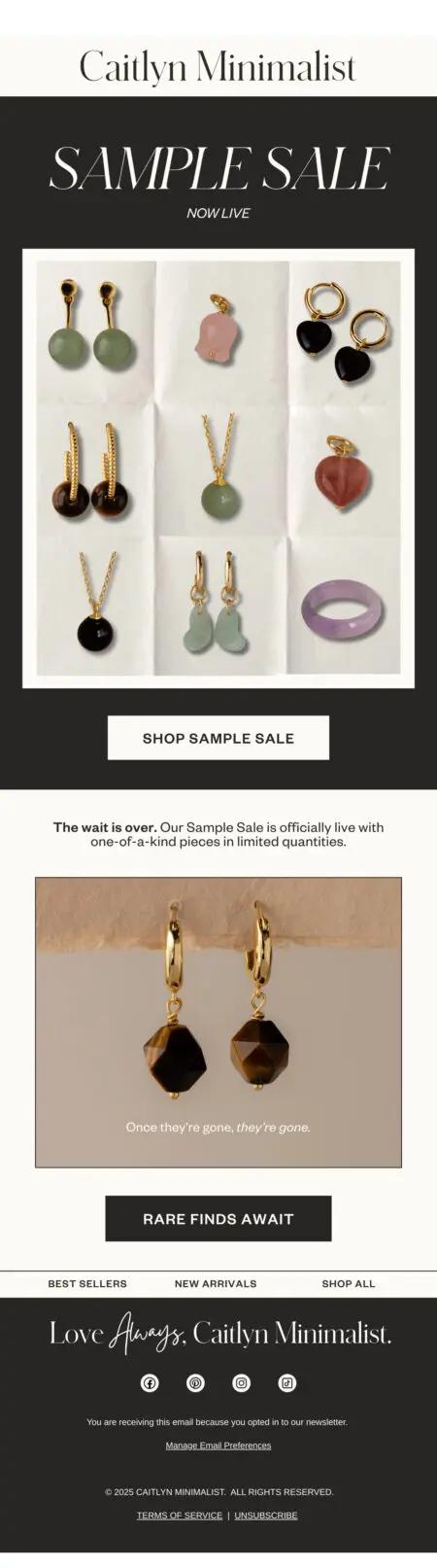
Here’s an email campaign example from jewelry brand Caitlyn Minimalist promoting a sample sale:
2. Transactional emails
A transactional email is a trigger-based automation designed to relay essential information to a customer, rather than generate sales. Common transactional emails include:
- Order confirmation emails
- Shipping confirmation emails
- Delivery updates
- Product subscription updates
- Account updates
Importantly, a customer doesn’t need to subscribe to your email list in order to receive transactional emails. That means people who unsubscribe from your list, aka suppressed email addresses, will still receive transactional emails, unless:
- The email bounces too many times.
- The email address is invalid.
- The recipient previously marked a message as spam.
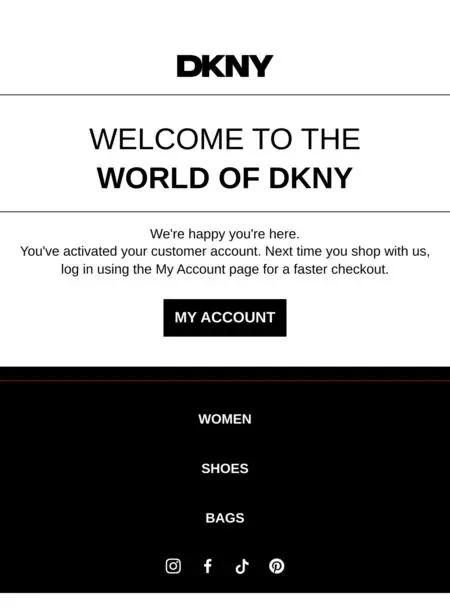
Here’s an example of a straightforward, on-brand account creation confirmation email from fashion brand DKNY:
3. Educational emails
Like promotional emails, educational emails can be either campaigns or automations. What they can’t be is—you guessed it—promotional.
The goal of an educational email is to educate your audience, not sell them something. Common types of educational emails include:
- Welcome flows that introduce new subscribers to your brand’s background and mission
- Brand newsletters that showcase your employees, customer testimonials, or efforts to give back to the community
- Post-purchase emails with tips on how to use or style a product
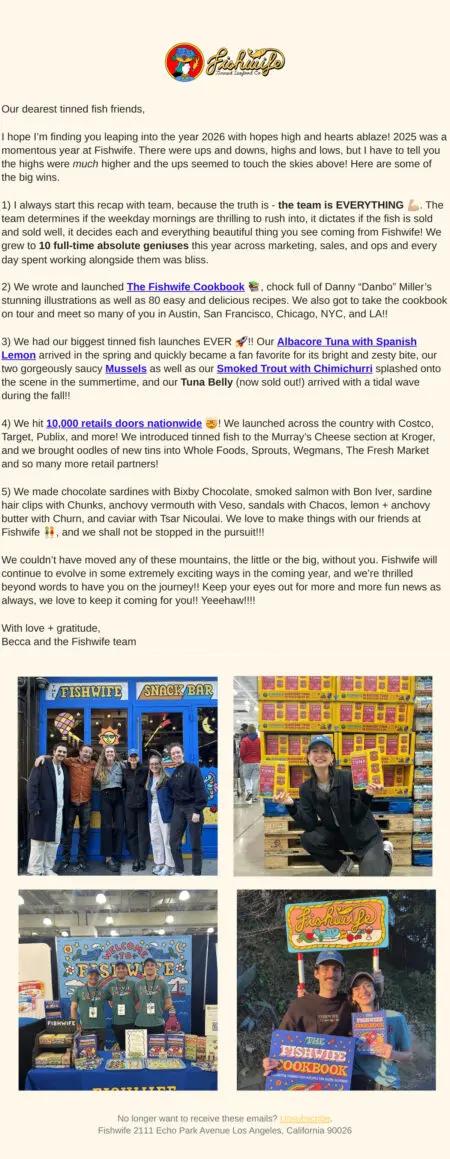
Here, take a look at tinned fish brand Fishwife’s thoughtful email newsletter summing up their year:
How does email marketing work?
The best thing about email marketing is that it’s (virtually) free. It’s also low-risk because it’s easy to get started and test out—especially these days, thanks to AI.
If you’re ready for a deep dive, read our blog on creating an email marketing strategy. Otherwise, here’s a quick overview of how it works:
- Conduct an audience and content audit. Track customer sentiment and feedback (AI can help, here), conduct market research, and talk with your customer service and product development teams to get an idea of your audience’s lifestyles, needs, and pain points. This will inform your segmentation strategy later.
- Set email marketing goals that align with your overall brand goals. For example, if you’re just starting out, your goal might be email list growth. If you have a solid base of subscribers who are ready to buy, your goal might be revenue or retention.
- Choose the right tech. Email marketing platforms are a dime a dozen. What’s better is a B2C CRM that collects and stores all your customer data in a single source of truth, so every email you send, from a BFCM campaign to a customer service follow-up, is informed by real customer behaviors and preferences.
- Build your email list. You can’t send emails if you don’t have email addresses to send them to. Sign-up forms are the fastest way to start collecting contact information in exchange for incentives like discounts or exclusive content. You can use AI to automatically display sign-up forms when they’re most likely to convert people.
- Collect as much data as possible. Along with contact information, consider asking new subscribers for product preferences or personal details, like hair or skin type, at the point of sign-up. You can also use quizzes and post-purchase surveys to collect this kind of valuable zero-party data that will help you segment your list and personalize your messaging accordingly later on.
- Tailor emails to each stage of the customer journey. Different stages of the customer journey require different email types and content. Dissect each stage to define what types of email campaigns or automations make the most sense for customers. An AI marketing agent can help you map this out with just your website URL—no prompting required.
- Design your emails and determine your send cadence. Follow best practices for email design and content, here (an AI marketing agent can help with that, too). Different kinds of AI can make it easier to remix your photos, or even help you understand which channels and what send times are most likely to engage individual customers.
- Test and optimize. Test email subject lines, CTA copy or placement, images, layouts, and more for performance metrics like clicks and placed orders. Some AI even empowers you to run A/B tests that tell you which version of an email is most likely to resonate with an individual subscriber, not your entire audience.
- Track and monitor performance. Determine which email marketing KPIs matter most to you and your team. Click rate? Revenue per recipient? Placed order rate? Unsubscribe rate? List growth? Return on investment? Then monitor on a regular basis, making changes as needed.
What are email marketing best practices?
To get the most out of your email marketing program, you’ll need to keep a few email marketing best practices in mind, like:
- Work from a unified data foundation. When your email marketing lives in the same system that houses and analyzes your customer data, you can activate rich insights, build segments from any piece of data, and personalize each interaction in a way that makes each customer feel like you know them.
- Lean on AI to reach more people and work more efficiently. AI can keep your emails out of spam folders, improve deliverability, and automatically repair your sending reputation so that emails keep landing in inboxes. It can also generate on-brand email marketing plans, campaigns, flows, subject lines, and copy, so your team has more bandwidth to focus on creative, strategic thinking.
- Think beyond marketing. As a B2C brand trying to build long-lasting relationships with loyal customers, you know email marketing is only one piece of a much larger puzzle. Sure, that puzzle requires coordinating email with other marketing channels, like text messaging and WhatsApp. But it also requires aligning your marketing team and data with your customer service team, so you never miss an opportunity to connect meaningfully with a customer.
Klaviyo, the AI-first B2C CRM, brings customer data, omnichannel marketing automation, customer service, and analytics into a single platform. From easy drag-and-drop templates to customer service-triggered flows, that means everything you need to build lasting customer relationships with email marketing and beyond, all under one roof.