Every retention marketer knows the feeling: you did everything right. Great product, strong demand, thoughtful campaigns. But then, the product your shoppers want most is out of stock.
Most brands treat that as a loss.
I don’t.
When a product sells out, I see a list of high-intent shoppers raising their hands and saying, “I want this enough to wait.” The real question is: what do you do with that intent?
Until recently, the standard answer was: collect an email address, send a back-in-stock notification, and hope they see it in time.
But email inboxes are overloaded. It’s way too easy for that back-in-stock message to get buried under promotions, receipts, and random newsletters.
That’s where Klaviyo SMS changes everything.
As director of retention at Kulin, a performance marketing agency serving businesses around the world, I’ve watched brands miss out on text message marketing as a channel for too long. Keep reading to learn all about how I use the channel to increase revenue with back-in-stock messaging.
Why back-in-stock messaging belongs on SMS
When Klaviyo relaunched its back-in-stock functionality for pop-up forms to allow for SMS, it immediately clicked for me. Back-in-stock is a time-sensitive, high-intent moment. Don’t waste it on email, the noisiest channel.
SMS is different because:
- It’s more direct and intimate—what I think of as a one-to-one channel.
- It’s better suited to urgency. If a product might sell out again, customers want to know right away. They’re more likely to see a message via text than in their email inbox.
It consistently outperforms email on engagement for many brands. For one client, we looked at the last 90 days and found an email click rate of 1.9%, compared to an SMS click rate of 5.3%.
Back-in-stock is exactly the type of notification where that difference matters. If there are limited units available and a subscriber doesn’t check their email until 6 p.m. for a restock that happened at 10 a.m., they might be too late. A text message lands on someone’s phone in real time and taps into that “I don’t want to miss this twice” energy.
“Using email only for a high-demand restock can be a subtle insult to the customer’s intent,” says Christian Nørbjerg Enger, co-founder and CPO at Segmento, a fast-growing, full-service marketing agency based in Denmark. “It communicates, ‘Get to this whenever you have time.’ We implemented SMS to match the physiological urgency of ‘I don’t want to miss this again,’ which aligns better with the customer’s desire.”
To be clear: I’m talking about shoppers who asked to be notified when a specific item is back. There’s a misconception that brands will “annoy people” with too many messages. In this use case, the opposite is true. People are annoyed if you don’t tell them when the item they’ve been waiting for is available again.
Using email only for a high-demand restock can be a subtle insult to the customer's intent.
How I combine Klaviyo back-in-stock forms and SMS
Here’s the basic pattern I use with clients that are on Shopify and Klaviyo SMS:
1. Start with a back-in-stock pop-up form on the product page
When a size or color is out of stock, shoppers see a clear option to sign up for a back-in-stock alert. Historically, this was email-only. Now, we make SMS part of that flow.
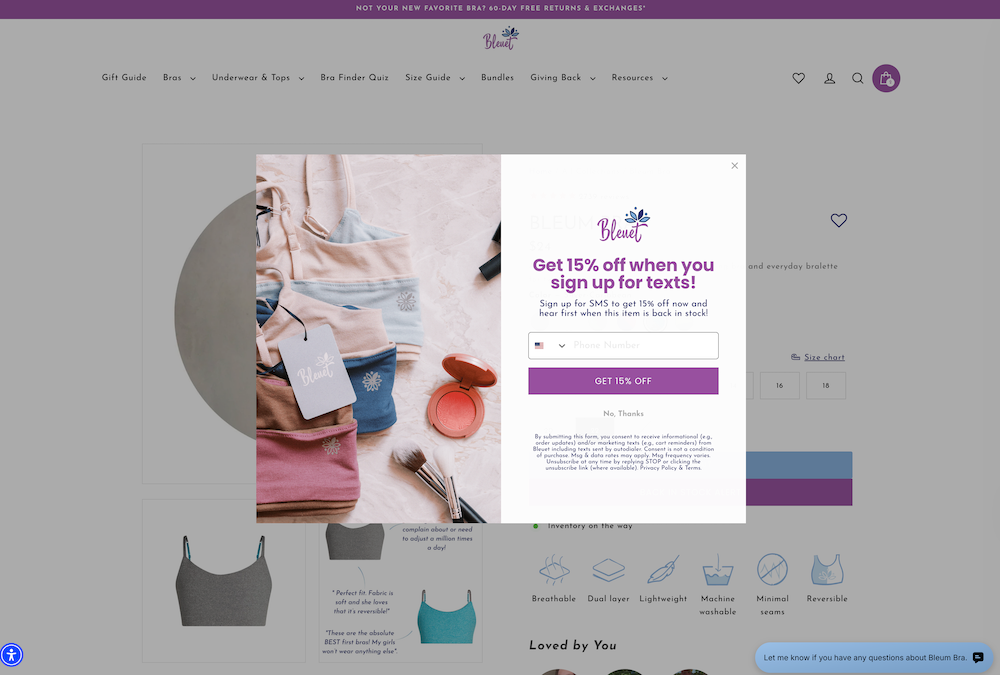
Image source: Bluet
2. Add an SMS opt-in step with an incentive
After someone enters their email address, we also prompt them to sign up for texts. These prompts typically say something like, “Get 15% off when you sign up for texts.”These customers are already highly motivated: they’ve searched for a specific style, size, and color. The discount is there to encourage them to place an order now for something else that’s in stock, while we also capture their consent on a channel that’s better suited for the eventual restock alert.
3. Send an immediate text message to drive a “right now” purchase
Once someone opts in, send a text like, “You’re on the list. The style you wanted is coming back soon. As a thank you, enjoy 15% off your next order with code ______.” That text includes a link back to the website so they can shop for something else while they wait. We’re not letting them drift back into scrolling or email. We’re getting them right back on site.
4. Use Klaviyo’s back-in-stock flow to trigger email and SMS
On the flow side, Klaviyo listens for the inventory event coming from Shopify. Once the product is back in stock, the flow sends both an email and a text message.The email is a solid backup. But in practice, SMS often wins on conversions. For one client, the back-in-stock email converts at 7.9%, and the SMS converts at 8.5%. That’s additional revenue from the same moment of intent, just on a better channel.
Real-life example: a Black Friday rain check that actually felt fair
One of my favorite recent examples comes from a smaller brand we work with. During Black Friday Cyber Monday (BFCM), inventory risk is real. High demand is a good problem, but if someone can’t get their size during the sale, it can leave a bad taste.
Here’s what we did:
- During BFCM, the back-in-stock text step didn’t promise “15% off your next order.”
- Instead, it said: “Sign up for SMS and we’ll give you a rain check for your Black Friday offer when this is back in stock.”
Meanwhile, on the back end in Klaviyo, we set up a specific flow for that period:
- While the BFCM sale was live, shoppers could join the waitlist and opt in to SMS.
- Once the sale ended, we turned off the promotional part of the flow, but kept the logic ready for the eventual restock.
- When that product came back, Klaviyo sent a text message with a unique discount code: “The bra you wanted is finally back in stock. Here’s your rain check 25% off code.”
“This strategy works wonders when you incorporate seasonality into the content,” says Nørbjerg Enger. “The content is going to resonate more with the customers and get them to remember your brand more, leading to more revenue down the line.”It’s a simple set-up if you’re comfortable with Klaviyo’s discount code functionality. And customers feel like you remembered them and made good on your promise, even though the big sale is technically over.
That’s the kind of experience that turns a one-time shopper into a repeat customer.
This strategy works wonders when you incorporate seasonality into the content.
Back-in-stock tip: smart batching so you don’t oversell
A question I get a lot is: “What if we don’t have enough inventory to notify everyone at once?”
Klaviyo’s back-in-stock settings are built to handle that reality.
For Shopify brands, you can configure things like:
- Minimum units before notifications start: For example, one client waits until there are at least 10 units available.
- How many subscribers get notified at a time: For example, one client only notifies 5 subscribers at a time.
That way, you’re not sending “It’s back!” messages to 100 people when you only have a handful of units available. You can also choose to notify everyone at once, but for most brands, batching is the safer choice.
This logic lives in the back-in-stock flow. Once you’ve set it up, it runs on its own, and you avoid the “You said it was in stock, but now it’s gone again” frustration.
“Sold out” isn’t a failure. It’s a signal.
A lot of brands see sold-out products and back-in-stock flows as a sign of poor inventory planning. I see something different.
When someone joins a waitlist for a specific size and color and is willing to hand over their phone number just to be sure they don’t miss it, that’s one of the clearest intent signals you’re going to get.
You’re not just tracking demand. You’re learning:
- Which products people are willing to wait for
- Which variants (sizes, colors, styles) are most in demand
- Who your highest-intent shoppers are
When you handle it thoughtfully, scarcity can actually build desire and loyalty. Some brands even intentionally limit certain SKUs to create that effect. I’m not saying everyone should do that, but if you’re selling out, you might as well turn that reality into a better customer experience and more revenue.
Combining Klaviyo back-in-stock forms with Klaviyo SMS is one of the simplest, most effective ways I’ve found to do that. It respects the shopper’s time, captures consent on a stronger channel, and makes sure the people who care most about your products hear from you in the moment that matters most.

Related content